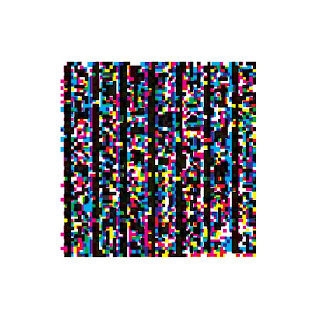
Here are some works in progress from my new print series of binary/hex/grid compositions.
The word simulacrum means: An image or representation of someone or something. (Oxford English Dictionary) But I prefer Brian Massumi's interpretation , which states:
"A copy is made in order to stand in for its model. A simulacrum has a different agenda, it enters different circuits."1
and,
"The thrust of the process is not to become an equivalent of the 'model' but to turn it and its world in order to open a new space for the simulacrum's own mad proliferation. The simulacrum affirms its own difference. It is not an implosion, but a differentiation; it is an index not of absolute proximity, but of galactic distances."2
This new series of mine, based on programing and file codes, attemps to explore the questions of copy and simulacrum by looking at the nature of an image from a digital perspective. What is an image? And when it is explored from different perspectives or encodings does its nature change?
This is unfinished work and is still in the process of being created.
1. Massumi, Brian. "The Simulacrum According to Deleuze and Guattari" Copyright no. 1, 1997.
2. Ibid.